Therapy for social anxiety: when to seek help, what treatment involves and how to choose
For years you have been dodging phone calls, dinners and meetings for fear of looking foolish. When to get help for social anxiety, what effective therapy is like and how long it takes.

You need to phone to change an appointment and you have been putting it off for three days. At the work dinner you rehearsed every sentence in your head before saying it, and when you got home you went back over every moment you think you looked foolish. It is not shyness: for years you have been arranging your life so that you never have to put yourself on show.
Social anxiety is common, and there is a psychological treatment for it with a lot of evidence behind it. If you are thinking about therapy for social anxiety, this guide explains when it is worth seeing a psychologist, which treatment works, what therapy is like from the inside, how long it takes, where medication fits in, whether it works online and how to choose a professional.
When to see a psychologist for social anxiety
The NHS describes it as a long-term and overwhelming fear of social situations that usually starts in the teenage years and, for many people, does not go away on its own without treatment. It is more than shyness: it affects everyday activities, self-confidence, relationships and work or school life. An analysis of the WHO World Mental Health Surveys, covering more than 142,000 people in 28 surveys, found that 4% had had it at some point in their lives, and that it tended to start early and to persist.
According to the NHS, you may have social anxiety if you:
- Worry about everyday activities such as meeting strangers, starting conversations, speaking on the phone, working or shopping.
- Avoid or worry a lot about group conversations, eating with company or parties.
- Always worry about doing something embarrassing, such as blushing, sweating or appearing incompetent.
- Find it hard to do things when others are watching and feel you are being judged all the time.
- Fear criticism, avoid eye contact or have low self-esteem.
- Often feel sick, sweat, tremble or have a pounding heart, or even have panic attacks.
The UK's NICE guideline suggests two questions to pick it up: whether you find yourself avoiding social situations or activities, and whether you feel fearful or embarrassed in them. A yes to either is worth a full assessment. To get your bearings first, the Social Anxiety Test has 15 questions about the last month and separates fear of judgement, avoidance and physical symptoms. If your fear is mostly about speaking in front of others, we cover it in Fear of public speaking: why you freeze and when it is social anxiety.
The NHS adds that many people with social anxiety also have depression, generalised anxiety or panic disorder. And if isolation or low mood have led to thoughts of harming yourself, call the 024 line in Spain (free, confidential, around the clock), 112, or your local emergency number.
Which treatment works for social anxiety
The NICE guideline is very specific. For adults, its first choice is individual cognitive behavioural therapy developed specifically for social anxiety, based on the Clark and Wells model or the Heimberg model. It advises against routinely offering group therapy instead of individual therapy: group CBT works better than most alternatives, but less well than individual CBT. For people who do not want that therapy, it suggests CBT-based supported self-help; for those who prefer medication, an SSRI antidepressant; and for those who turn down both, a short-term psychodynamic therapy designed for social anxiety, with a warning that it is less effective.
The evidence comes from a network meta-analysis by Mayo-Wilson and colleagues of 101 trials with more than 13,000 participants. Individual cognitive behavioural therapy had the largest effect of the psychological treatments, and together with SSRI and SNRI antidepressants it was the only one to beat its placebo. It is worth keeping expectations realistic: in a large multicentre trial by Leichsenring and colleagues with 495 patients, 60% of those who had cognitive behavioural therapy and 52% of those who had psychodynamic therapy responded to treatment, compared with 15% on the waiting list.
NICE is also clear about what should not be offered routinely: benzodiazepines, anticonvulsants, tricyclic antidepressants and antipsychotics, or mindfulness and supportive therapy as treatments for social anxiety. Nor botulinum toxin for sweating or surgery for blushing, a technique we look at in Fear of blushing (erythrophobia): why it happens and when it is social anxiety.
What therapy for social anxiety is like from the inside
For the Clark and Wells model, NICE describes these ingredients:
- Understanding your anxiety: how anticipation, attention focused on yourself and safety behaviours keep the fear going.
- Testing what safety behaviours do. Rehearsing sentences, clinging to your phone or talking fast seem to protect you, but in the session you find out that they keep the fear alive.
- Seeing yourself from outside. Video feedback of a conversation corrects the distorted image you have of how others see you.
- Training your attention outwards, on the conversation and the people, instead of monitoring yourself.
- Behavioural experiments to test your predictions, with homework.
- Working on painful memories, such as past humiliation or teasing, and on deep-seated beliefs about yourself.
- Changing the before and the after: the anticipation in the days beforehand and the replaying of everything you said afterwards.
- Relapse prevention.
The Heimberg model, the other option in the guideline, combines restructuring thoughts with graduated exposure to feared situations, both in sessions and as homework.
What about medication?
If you prefer medication, NICE recommends an SSRI, escitalopram or sertraline. If it works in the first three months, it advises continuing for at least another six months and coming off it gradually. If therapy has only partly worked, the two can be combined. Medication is decided by a doctor, not by a psychologist.
How long therapy for social anxiety takes
NICE sets out the length: in the Clark and Wells model, up to 14 sessions of 90 minutes over about four months; in the Heimberg model, 15 one-hour sessions plus a longer 90-minute one for exposure, also over about four months. Some sessions take place outside the consulting room, in real situations. The supported self-help it proposes as an alternative lasts three to four months, and short-term psychodynamic therapy six to eight. It is a treatment with a beginning and an end, not open-ended therapy.
Does online therapy for social anxiety work?
Yes. In a trial by David Clark and colleagues with 102 patients, the internet version of their cognitive therapy, with remote support from a therapist, achieved the same results as face-to-face therapy at the end of treatment and at follow-ups of up to 12 months, with 6.5 hours of therapist time instead of almost 16. Face-to-face therapy only had a small advantage on a behaviour test. A meta-analysis by Winter and colleagues, covering 31 studies and more than 2,900 people, found that remote cognitive behavioural therapy was at least as effective as face-to-face therapy.
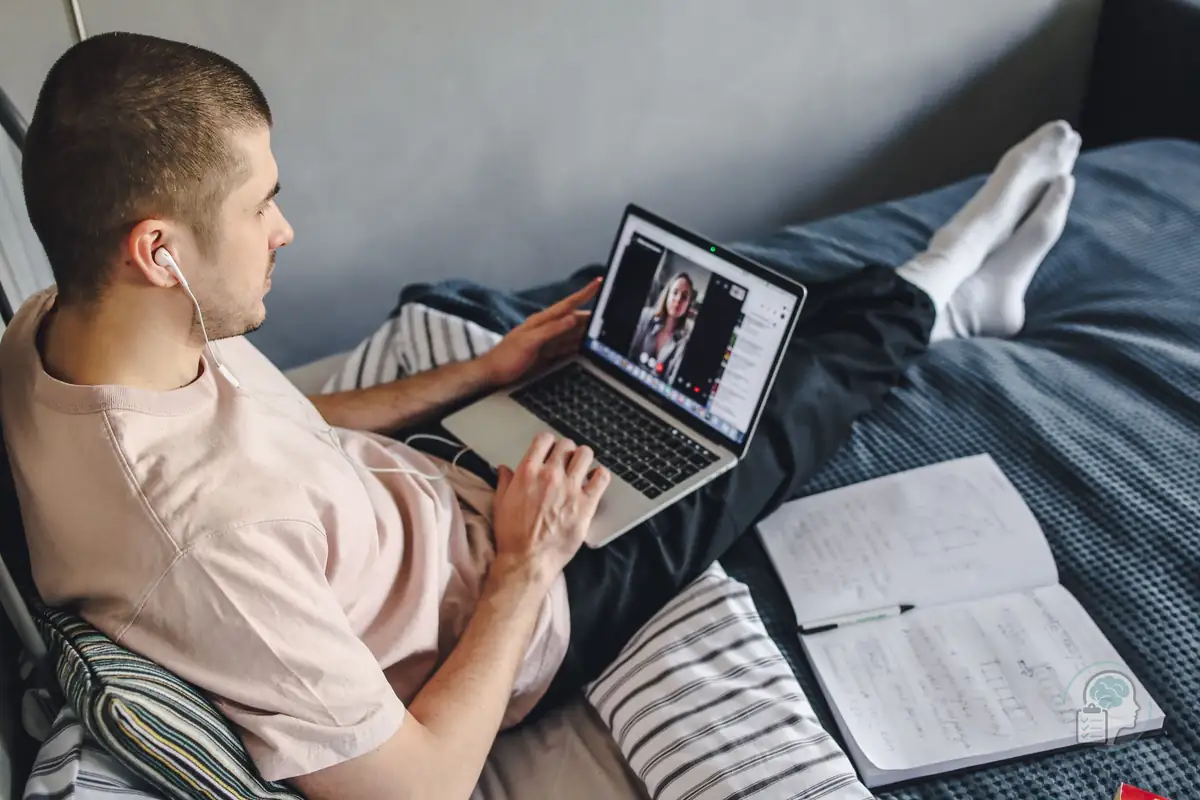
For someone with social anxiety, starting from home can take a lot of pressure off: no waiting room, no reception desk, no travel. But therapy does not stay on the screen: the experiments and exposure take place in real situations, between sessions. If you have never had therapy by video call, Online psychologist: how to choose well and what to expect from video-call therapy may help.
How to choose a psychologist for social anxiety
These checks help you get it right:
- Registration as a health professional. This comes first.
- CBT designed specifically for social anxiety. Ask directly whether they use the Clark and Wells model or the Heimberg model.
- Exposure and experiments as well as talking. Without testing your fears, therapy stays half done.
- Work on safety behaviours, anticipation and post-event replaying.
- Progress measured with questionnaires such as the SPIN or the LSAS, as NICE asks.
- A plan with goals and a rough idea of how many sessions it will take.
- Experience with trauma, if your fear comes from past humiliation or bullying.
- Coordination with your doctor, if you take medication or want to come off it.
A psychologist for social anxiety
At MyPsicoTest we recommend Xènia Capel Salcedo, a licensed clinical psychologist (COPC 14982) with a master's degree in Clinical Psychology and Psychotherapy. She sees clients in Igualada and Sant Sadurní d'Anoia and also through online therapy, and on her blog she has written an article about social anxiety. In it she explains that treatment usually combines cognitive restructuring, graduated exposure and, where needed, social skills training, and that when the fear grows out of childhood experiences of humiliation, bullying or rejection, EMDR can help process those memories. She also says that starting therapy online can be a less intimidating first step and that exposure to real situations is built up gradually. She works from an integrative, evidence-based approach: on her website she explains that she uses tools from cognitive behavioural therapy, EMDR, systemic therapy and person-centred therapy. Sessions are available in English, Spanish or Catalan, and the first contact is a free, no-commitment information consultation. She herself points out that in a serious crisis or psychiatric emergency, immediate in-person care is what is needed.
If your result worries you or you want a professional assessment, you can talk to Xènia Capel Salcedo, a licensed psychologist (COPC reg. 14982), who offers a free first consultation call and online therapy from anywhere.
MyPsicoTest team · Updated:
FAQ
Frequently asked questions
What kind of psychologist treats social anxiety?
A health psychologist with experience in cognitive behavioural therapy designed specifically for social anxiety, such as the Clark and Wells or Heimberg models, which NICE recommends as the first option for adults.
How many sessions does it take to overcome social anxiety?
NICE describes up to 14 sessions of 90 minutes over about four months in the Clark and Wells model, or around 16 sessions in the Heimberg model. It depends on the person.
Can therapy cure social anxiety?
Many people improve a great deal. In a trial with 495 patients, 60% responded to cognitive behavioural therapy, compared with 15% on the waiting list. Some keep a degree of social discomfort, but it stops limiting their lives.
Does group therapy work for social anxiety?
It works better than most alternatives, but less well than individual therapy, which is why NICE does not recommend it routinely in its place.
Does online therapy work for social anxiety?
Yes. In a trial with 102 patients, internet-based cognitive therapy with therapist support achieved the same results as face-to-face therapy and kept them for up to a year, with fewer therapist hours.
What medication is used for social anxiety?
If the person prefers medication, NICE recommends an SSRI antidepressant such as escitalopram or sertraline. It advises against routinely offering benzodiazepines. Medication is decided by a doctor.
Is shyness the same as social anxiety?
No. According to the NHS, social anxiety is more than shyness: it is a fear that does not go away and affects everyday life, self-confidence, relationships and work or school.
Related articles
Phone anxiety: why making calls feels so hard and when it is social anxiety
You let the phone ring, put off calling the doctor and write a script before you dial. Why it happens, when it is social anxiety and which test can help you measure it.

Fear of blushing (erythrophobia): why it happens and when it is social anxiety
You feel the heat rising in your face in the middle of a meeting and can think of nothing else. What the fear of blushing is, why it feeds itself and when it is social anxiety.

Fear of public speaking: why you freeze and when it is social anxiety
Your voice shakes, your mind goes blank and you count the minutes until it is over. It is the most common social fear. When it is just nerves and when it may be social anxiety.