Fear of public speaking: why you freeze and when it is social anxiety
Your voice shakes, your mind goes blank and you count the minutes until it is over. It is the most common social fear. When it is just nerves and when it may be social anxiety.

The presentation is on Thursday, but you have been sleeping badly since Monday. The moment comes and everything goes as you feared: your voice shakes, your hands sweat, your face burns and halfway through a sentence your mind goes blank. You get through it somehow and, on the way home, you go over every word you said and every gesture you think gave you away.
The fear of public speaking, sometimes called glossophobia although it is not a diagnostic term, is probably the most widely shared of all social fears. At the same time it comes wrapped in advice that does not help much, along the lines of "picture the audience in their underwear". Here we explain why it makes you freeze, what keeps it going, when it is just nerves and when it may be social anxiety, what works to get over it and which test can guide you.
What the fear of public speaking is, and why it is so common
Feeling nervous about public speaking is to be expected: your body is getting ready for something it sees as important. The problem starts when the fear is so intense that you have a very hard time every time, or it leads you to avoid these situations even when that costs you opportunities.
It is not an unusual fear. In the US National Comorbidity Survey Replication, which interviewed more than 9,000 adults, public speaking or performing was the most common social fear: 21.2% had experienced it at some point in their lives, followed closely by speaking up in a meeting or class, at 19.5%. If it happens to you, you are in very good company.
What happens in your body and your mind
MedlinePlus, the health information service of the US National Library of Medicine, lists blushing, difficulty talking, nausea, profuse sweating and trembling as common physical symptoms of social phobia, and places speaking in public among the most common fears of the people who have it. The NHS adds a pounding heartbeat and the feeling of being watched and judged all the time.
But what keeps the fear going is not so much the body as what happens in your mind before, during and after.
All your attention on yourself
While you speak, part of your mind is busy monitoring you: whether people can see you are blushing, whether your voice is shaking, whether you look as if you do not know what you are talking about. That monitoring makes you feel more exposed and takes attention away from what you are saying, which is exactly what makes you lose your thread. The UK NICE guideline on social anxiety includes exercises in therapy to show precisely the harmful effects of this self-focused attention, along with systematic training in turning your attention outwards.
There is also a bias working against you. Studies by the psychologist Thomas Gilovich and his colleagues described the so-called illusion of transparency: we tend to believe that what we feel inside shows on the outside far more than it really does. Therapy uses video precisely to correct the negative, distorted image people form of themselves while they speak.
The crutches that keep it going
Reading out everything you say, not looking up from the page, speaking very fast to get it over with, gripping the lectern, memorising your speech word for word or having a drink beforehand to loosen up. These are safety behaviours: they give a sense of control, but they stop you finding out that you would have managed without them, and the NICE guideline specifically works on them in therapy. The drink carries an extra risk: MedlinePlus warns that people with social phobia are at higher risk of alcohol or other substance misuse because they may come to rely on them to relax.
Before and after
The days beforehand go on imagining everything that could go wrong. And when it is over, the review begins: every sentence, every silence, every face in the audience. The NHS describes exactly this pattern in social anxiety, in which the worry comes before, during and after the situation, and the NICE guideline includes working on both the anticipation and the post-mortem as part of treatment.
Nerves, shyness or social anxiety: how to tell them apart
This is the important question. The NHS explains that social anxiety is more than shyness: it is a fear that does not go away and affects everyday activities, self-confidence, relationships and work or school life. MedlinePlus sums it up with a useful distinction: shy people are able to take part in social situations, whereas social anxiety affects the ability to function at work and in relationships.
Some people's fear is limited to speaking or performing in front of others, and the DSM-5-TR diagnostic manual covers this case with a specifier called "performance only". But that is not the most common picture. In the US survey, half of the people with a fear of public speaking met the criteria for social phobia, and almost nine in ten people with social phobia had that fear. The authors also found that performance fears and interaction fears went together, and that the more social fears a person had, the more severe the condition was.
Signs it may be more than nerves
- You avoid presentations, meetings or oral exams even when it costs you a promotion, a grade or a job.
- The fear spreads to other situations: phone calls, meeting new people, eating in front of others or giving your opinion in a group.
- You spend days anticipating and days going over it afterwards.
- The physical symptoms are very intense or turn into panic attacks.
- You need alcohol or something else to be able to face it.
If you recognise yourself in several of these, it is worth taking a social anxiety test. The NHS warns that for many people social anxiety does not go away on its own without treatment.
How to overcome the fear of public speaking
To overcome the fear of public speaking you do not need to become a brilliant speaker. You need to stop running away from it, gradually and in an orderly way, and change where you look while you speak.
Face it step by step
Avoidance brings relief but keeps the fear intact. What works is the opposite, done sensibly. The NHS recommends breaking difficult situations down into smaller parts and working on feeling more relaxed with each one, and MedlinePlus notes that gradual exposure to real-life situations has been used with success. An example ladder: ask one question in a meeting, then say something short in front of three colleagues you trust, then give a short presentation and later a longer one.
Turn your attention outwards
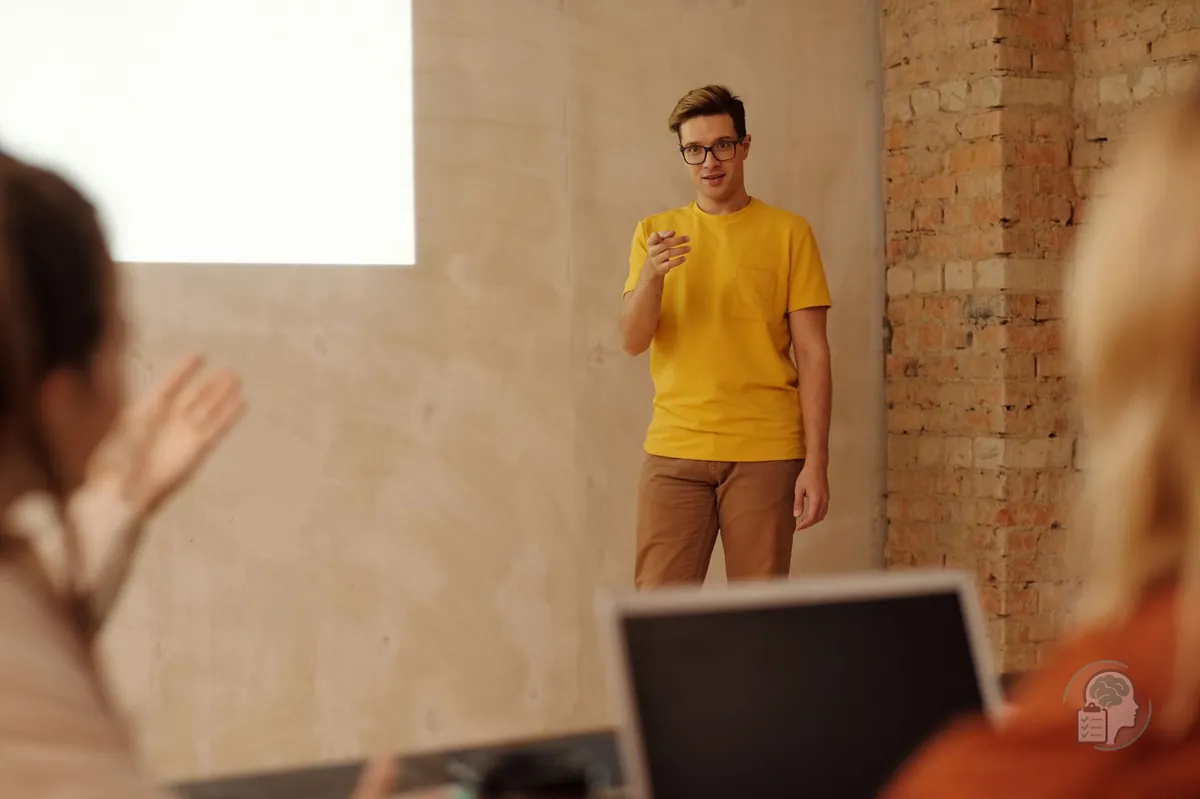
Instead of monitoring how your voice sounds, pay attention to the audience: who is nodding, which part interests them, what question they ask. The NHS advises focusing on what people are saying rather than assuming the worst. It is hard at first, but it is a skill you can train.
Drop the crutches one at a time
Try looking at the audience, even if only now and then, speaking from a list of key points instead of a full script, or pausing instead of speeding up. Every crutch you drop shows you that you could manage without it.
Prepare without aiming for perfection
Rehearse out loud, not just in your head, and if possible in front of someone. Knowing your material well reduces uncertainty; aiming for no nerves to show at all increases it. And there is nothing wrong with saying "sorry, I have lost my thread" and looking at your notes.
Look after your body
The relaxation techniques and breathing exercises the NHS recommends help bring your arousal down before you start. MedlinePlus also advises cutting down on caffeine and other stimulants, and keeping up exercise, sleep and regular mealtimes.
When to get help and which treatment works
If the fear is costing you opportunities or spreading to other situations, there is treatment, and it works. The NHS considers cognitive behavioural therapy the best treatment for social anxiety. It also includes guided self-help with materials based on that therapy and, in some cases, SSRI antidepressants.
The NICE guideline goes further and recommends that adults are offered individual cognitive behavioural therapy developed specifically for social anxiety. In the Clark and Wells model this means up to 14 sessions over about four months, covering exactly what you have read here: self-focused attention, safety behaviours, video feedback to correct the distorted self-image, experiments to test your fears, and work on the anticipation and the post-mortem. The same guideline advises against routinely offering benzodiazepines for social anxiety; we compare medication and therapy in Anxiety medication or therapy: what works better for anxiety. And we explain how the cognitive behavioural approach works in Cognitive behavioural therapy: what it is, how it works and what it treats.
Which test helps you find out if it is social anxiety
The Social Anxiety Test has 15 questions about the last month and measures three dimensions: fear of other people's judgement, avoidance of social situations and physical symptoms. One of them asks precisely about avoiding speaking in public or speaking up in meetings. The result gives you an overall score and a score for each dimension, so you can see whether what weighs most is the fear of judgement, the avoidance or the physical symptoms. If your score is high, and especially if the fear also shows up in situations that have nothing to do with public speaking, it is worth talking to a professional.
Two more tests complete the picture. If tension and worry follow you outside social situations too, the Anxiety Test measures general anxiety. And since the NHS includes low self-esteem among the features of social anxiety, the Self-Esteem Test helps you see whether the fear of looking bad comes from a poor opinion of yourself. If you also feel you are not up to what you are presenting, Impostor syndrome: why you feel you are about to be found out will interest you too, and if your nerves have ever ended in a crisis, see Panic attack: what it is, why it feels like a heart attack and what to do.
They are all free, anonymous and take a few minutes, and the result is calculated on your own device. The rest are in the psychological tests catalogue.
If your result worries you or you want a professional assessment, you can talk to Xènia Capel Salcedo, a licensed psychologist (COPC reg. 14982), who offers a free first consultation call and online therapy from anywhere.
MyPsicoTest team · Updated:
FAQ
Frequently asked questions
Is it normal to be afraid of public speaking?
Yes. It is the most common social fear: in a large US survey, more than one in five adults had felt it at some point. Feeling nervous before speaking to a group is to be expected; it becomes a problem when it gives you a very hard time every time or leads you to avoid important situations.
What is glossophobia?
It is the popular name for an intense fear of public speaking. It is not a diagnosis in itself: when that fear is persistent and causes significant distress, professionals assess it as part of social anxiety, which in some cases is limited to performance situations such as speaking or performing in front of others.
Is the fear of public speaking social anxiety?
It can be, but not always. In the US survey, half of the people with a fear of public speaking met the criteria for social phobia. The key is whether the fear spreads to other situations, whether it leads you to avoid important things and how much it interferes with your life. A social anxiety test helps you see this.
Can you get over the fear of public speaking?
Yes. What helps most is gradual exposure, dropping safety behaviours and learning to put your attention on the audience rather than on yourself. When the fear is part of social anxiety, specific cognitive behavioural therapy is the treatment with the strongest backing.
What should I do if my mind goes blank when speaking in public?
Stop, breathe and look at your notes: a pause of a few seconds is perfectly acceptable. Going back to the last idea you mentioned usually gives you your thread back. Remember, too, that we tend to believe our nerves show far more than they really do.
Does anxiety medication help with public speaking?
It is not something to decide on your own. The NICE guideline advises against routinely offering benzodiazepines to treat social anxiety, and MedlinePlus explains that when sedatives are prescribed, it is in limited amounts and under medical direction.
Which test should I take to find out if I have social anxiety?
The MyPsicoTest social anxiety test has 15 questions and measures fear of judgement, avoidance and physical symptoms. It is free and anonymous, and it gives you an indicative score for each dimension. It is not a diagnosis, but it helps you decide whether it is worth seeing a professional.
Related articles
Phone anxiety: why making calls feels so hard and when it is social anxiety
You let the phone ring, put off calling the doctor and write a script before you dial. Why it happens, when it is social anxiety and which test can help you measure it.

Therapy for social anxiety: when to seek help, what treatment involves and how to choose
For years you have been dodging phone calls, dinners and meetings for fear of looking foolish. When to get help for social anxiety, what effective therapy is like and how long it takes.

Fear of blushing (erythrophobia): why it happens and when it is social anxiety
You feel the heat rising in your face in the middle of a meeting and can think of nothing else. What the fear of blushing is, why it feeds itself and when it is social anxiety.