Therapy for body dysmorphia: when to seek help, what treatment involves and how to choose
You spend hours at the mirror fixated on a flaw nobody else can see. When to seek help for body dysmorphia and what the therapy that works looks like.
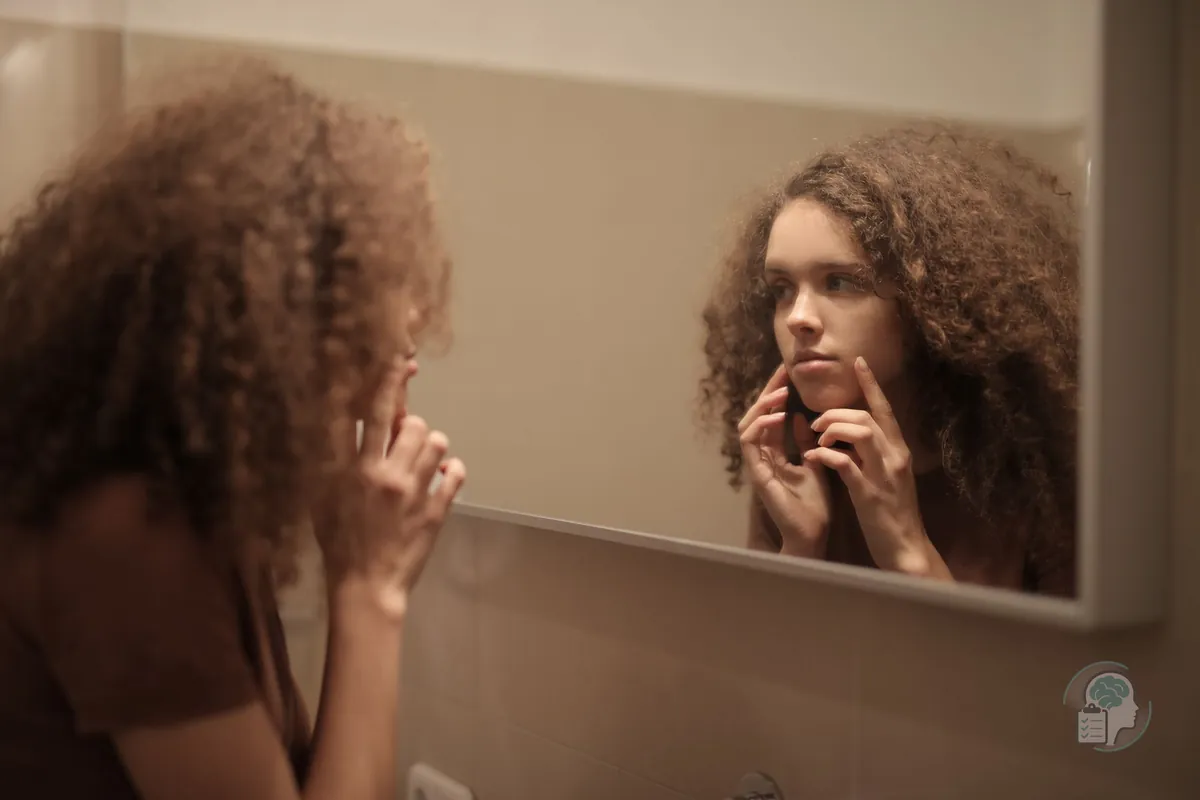
Before leaving the house you go back to the mirror for the third time. You lean in, turn your face towards the light and there it is: that mark on your skin, that nose, that asymmetry nobody else seems to notice. You put on a cap, change your jumper and end up cancelling your plans. When someone tells you that you look fine, you assume they are just being polite.
If worrying about a flaw eats up hours of your day, it may not be ordinary insecurity but body dysmorphia, also known as body dysmorphic disorder or BDD. If you are thinking about seeing a psychologist and looking for therapy for body dysmorphia, this guide explains when it is worth going, which treatment works, what therapy looks like from the inside, why surgery does not fix it, how long it takes, whether it works online and how to choose a professional.
When to see a psychologist for body dysmorphia
The NHS describes it as a mental health condition in which a person spends a lot of time worrying about flaws in their appearance that are often unnoticeable to others. It is most common in teenagers and young adults, it affects both men and women, and it has nothing to do with being vain. A review by Veale and colleagues estimated it at 1.9% of adults in the community, 2.2% of adolescents and 3.3% of students.
According to the NHS, you might have body dysmorphia if you:
- Worry a lot about a specific area of your body, particularly your face.
- Spend a lot of time comparing your looks with other people's.
- Look at yourself in mirrors a lot or avoid them altogether.
- Go to great lengths to hide the flaw, for example by spending a long time combing your hair, applying make-up or choosing clothes.
- Pick at your skin to make it "smooth".
NICE, the body that issues clinical guidance in England, suggests five questions to help identify it: whether you worry a lot about the way you look and wish you could think about it less, what specific concerns you have, how many hours a day your appearance is on your mind (more than one is considered excessive), what effect it has on your life and whether it makes it hard to work or be with friends. If you recognise yourself, it is worth getting it looked at.
There is another reason not to wait. The NHS warns that it can lead to depression, self-harm and even thoughts of suicide, and a meta-analysis by Angelakis and colleagues found it was linked to more suicidal thoughts and attempts, although the authors urge caution because the available studies were few and of low quality. If you have thoughts of harming yourself, call the 024 line in Spain (free, confidential, around the clock), 112, or your local emergency number.
MyPsicoTest does not have a specific body dysmorphia test, but the OCD Test asks about obsessions and rituals, such as checking things again and again or asking others for reassurance, which are very similar to those in body dysmorphia: since the DSM-5, the two have shared a chapter. And if your main worry is your weight or shape, the Eating Disorder Test, which asks whether you avoid mirrors and photos or keep checking the parts of your body you dislike, helps you gauge whether there may be an eating disorder.
Body dysmorphia in men: muscle dysmorphia
Veale's review found more women than men in most settings, but not in cosmetic or dermatology clinics. In boys and young men, pressure to have a lean, muscular body can turn into muscle dysmorphia, sometimes called bigorexia: a preoccupation with being too small or not muscular enough, even when others see a normal or even very toned body. The DSM-5 recognises it as a specific form of body dysmorphic disorder.
Which treatment works for body dysmorphia
NICE recommends cognitive behavioural therapy (CBT) with exposure and response prevention, tailored to body dysmorphic disorder: for mild cases, individually or in a group; for moderate cases, a choice between more intensive individual CBT and an SSRI antidepressant; and for severe cases, both together. For children and young people, the first option is the same therapy with the family involved.
The therapy is well supported. A meta-analysis by Harrison and colleagues of seven trials and 299 patients found that CBT reduced symptoms substantially compared with a waiting list or a placebo therapy, also improved depression and the ability to see the flaw differently, and that the improvement held months later. The authors do acknowledge that there is still a lot of room for improvement.
What therapy for body dysmorphia looks like from the inside
Good therapy is not about telling you over and over that you look fine. It works on what keeps the problem going: the rituals, the avoidance and the way you read what you see in the mirror. It usually covers these points:
- Understanding the cycle: the thought about the flaw triggers distress; checking, hiding it or comparing yourself calms it for a moment but makes it stronger.
- Cutting down the rituals: mirror checking, camouflage, touching up and needing someone to tell you that you look fine.
- Gradually facing what you avoid: photos, going out without make-up or without a cap, the beach, changing rooms or plans with other people. The NHS describes it as gradually facing situations that would normally make you think obsessively about your appearance.
- Questioning the thoughts about the flaw: treating them as ideas your mind repeats rather than as facts, instead of taking for granted that it is hideous and that everyone can see it.
- Working on shame and self-esteem, so that your worth stops depending on the mirror. If self-esteem is the underlying issue, we explain it in Therapy for low self-esteem: when to seek help and what is worked on in therapy.
- Preventing relapse, knowing what to do if the worry comes back or moves to another part of the body.
Exposure and response prevention is the same technique used for OCD, and we explain it in detail in Therapy for OCD: what treatment involves, how long it takes and how to choose.
What about medication?
If it is needed, the NHS explains that fluoxetine is the SSRI most commonly used for body dysmorphia, that it may take up to 12 weeks to have an effect and that, if it works, it is continued for several months and then reduced slowly. It also asks for close monitoring, especially in the first few weeks, of people under 30 and anyone with a history of suicidal behaviour. Medication is decided by a doctor, not by the psychologist.
Why cosmetic surgery does not fix body dysmorphia
Since the problem is felt in the body, it seems logical to look for the solution in the body. But it does not work. In a study by Crerand, Phillips and colleagues of 200 people with body dysmorphia, 71% had sought medical or cosmetic treatment and 64% had received it, mostly dermatological and then surgery, with nose surgery the most frequent. These treatments rarely improved the body dysmorphia. An earlier study by Phillips of 289 patients reached the same conclusion.
So it is no surprise to find body dysmorphia in those clinics: Veale's review estimated it at 13.2% of people attending cosmetic surgery and 20.1% of those seeking rhinoplasty. NICE says that anyone with suspected or diagnosed body dysmorphic disorder who wants cosmetic surgery or dermatological treatment should first be assessed by a mental health professional with expertise in the condition.
How long therapy for body dysmorphia takes
It depends on how severe it is and whether there is depression, OCD or other problems at the same time. The internet programme BDD-NET, which we discuss below, lasts 12 weeks, and NICE reserves more intensive therapy for moderate or severe cases. As a reference point, the same guideline recommends reviewing the plan with the team if improvement is not enough after more than ten hours of therapy. What matters is starting: the NHS warns that the symptoms probably will not go away without treatment and may get worse.
Does online therapy work for body dysmorphia?
Yes. Online therapy for body dysmorphia has trials behind it. In a trial by Enander and colleagues published in the BMJ, with 94 adults, 12 weeks of therapist-guided internet CBT clearly outperformed online supportive therapy: at follow-up, 56% responded compared with 13%, and satisfaction was high. A later study, with 32 patients in nine countries, had similar results.
For someone who avoids being seen, starting from home can be much easier. That said, the exposure eventually happens in real life: photos, the street, other people. If you have never had therapy by video call, Online psychologist: how to choose well and what to expect from video-call therapy may help.
How to choose a psychologist for body dysmorphia
These checks help you get it right:
- Registration as a health professional. This comes first.
- Experience in CBT with exposure and response prevention adapted to body dysmorphia, as NICE recommends.
- Someone who does not simply reassure you about your appearance: being told you look fine brings relief for a while but keeps the problem going.
- Knowledge of the link with OCD and eating disorders, which often go together.
- Coordination with your doctor if you take medication, and a psychological assessment before any cosmetic treatment.
- Flexibility: online sessions if leaving the house or being seen is hard for you.
- A space free of judgement, where nobody thinks it is vanity.
A psychologist for body dysmorphia
At MyPsicoTest we recommend Xènia Capel Salcedo, a licensed clinical psychologist (COPC 14982) with a master's degree in Clinical Psychology and Psychotherapy whose specialties include eating disorders. She sees clients in Igualada and Sant Sadurní d'Anoia and also through online therapy, and on her blog she has written an article about body dysmorphia. In it she explains that the aim of therapy is not to convince the person that they look fine, but to change their relationship with the thoughts and behaviours around their appearance: cutting down mirror checking, camouflage and reassurance seeking, questioning thoughts about the flaw, gradually returning to what has been avoided and rebuilding a self-esteem that does not depend on the mirror. She is also clear that cosmetic surgery is not the answer. She works from an integrative, evidence-based approach: on her website she explains that she uses tools from cognitive behavioural therapy, EMDR, systemic therapy and person-centred therapy. Sessions are available in English, Spanish or Catalan, and the first contact is a free, no-commitment information consultation. She herself points out that in a serious crisis or psychiatric emergency, immediate in-person care is what is needed.
If your result worries you or you want a professional assessment, you can talk to Xènia Capel Salcedo, a licensed psychologist (COPC reg. 14982), who offers a free first consultation call and online therapy from anywhere.
MyPsicoTest team · Updated:
FAQ
Frequently asked questions
What is body dysmorphia?
It is a mental health condition in which a person spends a lot of time worrying about one or more flaws in their appearance that others cannot see or see as minor. It is also called body dysmorphic disorder or BDD.
What are the symptoms of body dysmorphia?
Worrying a lot about one area of your body, particularly your face, comparing yourself with others, looking in the mirror a lot or avoiding it, going to great lengths to hide the flaw, picking at your skin and avoiding photos or plans for fear that it shows.
Is it the same as vanity or low self-esteem?
No. The NHS points out that having body dysmorphia does not mean you are vain or self-obsessed: far from feeling attractive, the person lives with distress and shame about a flaw they believe is plain to see. Nor is it simply low self-esteem, although fragile self-esteem can feed it: it is a disorder with its own obsessions and rituals, which is why it needs specific treatment.
Which therapy works for body dysmorphia?
Cognitive behavioural therapy with exposure and response prevention, as recommended by NICE. A meta-analysis of seven trials found that it substantially reduced symptoms and also depression.
Does cosmetic surgery help body dysmorphia?
Hardly ever. In a study of 200 people, most had sought cosmetic or dermatological treatment and it rarely improved their body dysmorphia. NICE asks for a psychological assessment before surgery.
Does online therapy work for body dysmorphia?
Yes. In a trial with 94 adults, therapist-guided internet CBT led to 56% of participants responding, compared with 13% with supportive therapy.
Is body dysmorphia a type of OCD?
They are closely related: since the DSM-5 they have shared a chapter, both involve intrusive thoughts and rituals, and both are treated with the same technique, exposure and response prevention. But they are different disorders.
Related articles

Contamination OCD: why washing never feels like enough and when it is a disorder
You wash your hands until they sting and the feeling of dirt will not go away. Why it happens, when it is contamination OCD and which test can help you find out.

Checking OCD: why you check again and again and when it becomes a disorder
You get down to the street and go back up to look at the cooker. Why one check is never enough, when it is checking OCD and which test can help you get your bearings.
Therapy for OCD: what treatment involves, how long it takes and how to choose
You check the door five times, wash your hands until they are sore or cannot shake a thought out of your head. When to see a psychologist for OCD and what the therapy that works is like.