
Stages of grief: what the evidence says about the five-stage model
Denial, anger, bargaining, depression, acceptance. Everyone knows the five stages of grief, and almost nobody knows they were not formulated for grief at all.

Denial, anger, bargaining, depression, acceptance. It is probably the best-known piece of psychology in the world: people quote it at funerals, it turns up in television dramas, and entire textbooks repeat it. It is also among the worst applied. Millions of people have gone through a loss believing there was an itinerary to follow, and felt strange for not fitting into it.
The stages of grief everybody knows were not formulated for grief. And since they were formulated, the research has gone in a different direction. It is worth setting out which one, because knowing what to actually expect saves a fair amount of additional suffering.
Where the five stages of grief come from
The model was published by the Swiss-American psychiatrist Elisabeth Kübler-Ross in 1969, in a book called On Death and Dying. It grew out of genuinely valuable work: for years she interviewed patients at a Chicago hospital at a time when terminally ill people simply were not told about their situation. She listened to them and gave them a voice.
And here is the detail that almost never gets mentioned. Those interviews were with people facing their own death, not with people who had lost someone. The five stages described how some of those patients came to terms with a terminal diagnosis. The leap across to bereavement came later, through popularisation, and ended up as the reference framework for something that had not been studied.
Kübler-Ross herself tried to correct this later on. In her final book, written with David Kessler and published in 2005, she was already warning that the stages were not stops on a route or an order you had to pass through. The correction came too late: by then the model was living a life of its own.
Why the model does not work as a map
When the sequence has been tested empirically, it does not show up. The most cited study on this followed bereaved people for two years and found something other than what was predicted: the dominant feeling from the very start was not denial but yearning. And acceptance did not arrive at the end as a finishing line; it was the most frequent state almost from the beginning, and it grew gradually.
The UK's National Health Service, which does list the stages in its information on grief, pairs them with an explicit warning: you may not experience all of them, they may not happen in a particular order, and you may not move smoothly between them.
The problem with believing otherwise is not academic. It causes two concrete harms. First, thinking you are doing it wrong: someone still angry at four months assumes they are stuck, when there is no box they were supposed to be in. Second, the people around them start applying pressure — "you should be at acceptance by now" — at exactly the point when a timetable is the last thing needed.
What grief actually looks like
The models that describe it best do not talk about stages but about movement.
You oscillate, you do not advance
The dual process model, put forward by Margaret Stroebe and Henk Schut in the late 1990s, describes a swing between two kinds of day. There are loss-oriented days: crying, remembering, looking at photographs, missing them. And there are days oriented towards the life that carries on: going back to work, dealing with paperwork, laughing with someone, learning to do the things the other person used to do.
Neither is the right one. Adapting consists precisely in being able to oscillate between the two, not in settling into one. People who only do the first get stuck; people who only do the second usually pay for it later.
It arrives in waves, not in a straight line
Grief does not decrease in intensity steadily. It works in jolts: reasonably stable weeks and then a wave arriving unannounced because of a smell, a song in the supermarket, or a bank notification in the name of someone who is no longer there. Anniversaries and first times — the first birthday, the first Christmas — concentrate a good share of those waves.
Intensity returning at eight months does not mean going backwards. It means this is how it works.
The body registers it too
Tiredness that sleep does not fix, tightness in the chest, breathlessness, digestive trouble, diffuse aches, a weaker immune system. Grief has a real and well-described physical expression, and it helps to know that so as not to panic or attribute everything to some new illness. That said, physical symptoms that are intense or persistent get checked with a doctor like any other symptom.
There is no timetable
The question "how long does it last?" has no answer in months. It depends on the bond, the circumstances of the death, the support network, whether there was unfinished business. What research does describe well is the shape: intensity tends to ease unevenly across the first and second year, and what changes is not that it stops hurting but that it stops occupying the centre.
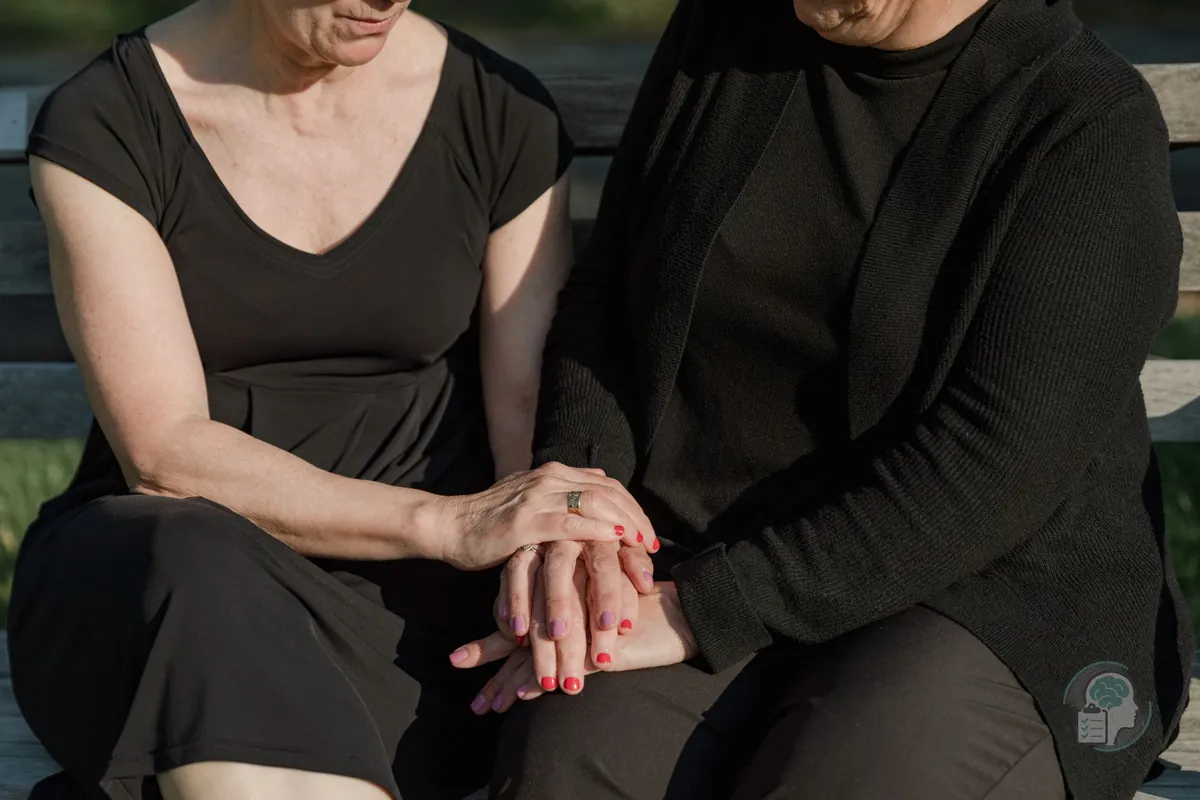
What is to be expected in the first months
It helps to know what falls within the ordinary, even when it is frightening. The NHS lists among the usual reactions the initial shock and numbness, intense sadness with a lot of crying, exhaustion, anger — at the person who died, at the doctors, at yourself — and guilt, which tends to be among the heaviest: over something said, something not said, not having been able to prevent it.
There are more normal things that people keep quiet about for fear of how they sound. Feeling relief when death comes after a long illness. Being in a good mood on an ordinary Tuesday. Talking out loud to someone who is no longer there. Hearing their voice or sensing their presence in the first months, something reported fairly often and which indicates no disorder at all.
And not crying is normal too. The absence of tears does not measure love, nor does it mean the grief will detonate later on.
When grief becomes complicated
In most cases grief runs its course without treatment. Around one in ten people develops what is now recognised as a clinical condition in its own right: prolonged grief disorder, added to the World Health Organization's international classification of diseases and to the American DSM-5-TR manual in 2022.
What defines it is not feeling pain but the pain staying frozen at first-month intensity. Persistent yearning or constant preoccupation with the person who died, alongside intense emotional suffering, an inability to accept the loss, numbness, a sense that life has lost meaning, avoidance of anything that recalls that person or, conversely, an inability to think about anything else. And, above all, a clear deterioration in day-to-day functioning.
The timeframes differ by manual: the WHO classification speaks of at least six months since the loss, while DSM-5-TR requires twelve in adults. In both cases the reaction must also clearly exceed what is expected within the person's cultural setting.
Risk goes up with sudden or violent deaths, the loss of a child, isolation, a history of depression, and deaths nobody was able to accompany. If the death was traumatic and the images return uncontrollably, the approach looks more like trauma work; we explain it in our article on EMDR therapy: what it is, how it works and how it treats trauma.
One note that cannot be left out: if thoughts of ending your life appear at any point, that is dealt with today, not in a month's time. In Spain there is the 024 helpline, free, confidential and available 24 hours a day, and 112 if there is immediate danger; elsewhere, contact your local emergency services.
What helps and what does not
Start with what does not. Stock phrases — "you have to be strong", "at least they did not suffer", "time heals everything" — comfort the person saying them, not the person hearing them. Nor does it help to clear away every photograph and belonging at once, or the opposite, leaving the room untouched for years. And alcohol, which shows up early as an anaesthetic, makes sleep and mood worse within a few weeks.
What does hold things up:
- Sleeping and eating with a minimum of regularity. It is the first thing to break and the thing that amplifies everything else. MedlinePlus has general guidance for those first weeks.
- Talking to someone who knows how to listen without offering solutions. Telling the story several times is not going round in circles: it is how it gets integrated.
- Rituals, including invented ones. A marked anniversary, a letter that never gets sent, visiting a particular place. They give the pain a time and a place instead of leaving it loose all day.
- Going back to activity before you feel like it. Waiting to feel like it usually means waiting too long; the mood follows the movement, not the other way round.
- Accepting concrete help. People who ask "do you need anything?" rarely get an answer. It is much easier to say yes to "I'll bring dinner on Thursday".
When to seek professional help
You do not need a diagnosis to go to therapy for grief, and you do not have to wait six months either. The sensible reasons are fairly clear: months have passed with no relief at all, day-to-day functioning is still broken, guilt or anger take up all the space, the death was traumatic, or symptoms appear that go beyond sadness.
That last point causes the most confusion, because grief and depression overlap a great deal and are not the same thing. In grief the pain comes in waves and the capacity for enjoyment survives in the gaps; in depression the mood is flat and constant, and self-esteem collapses. We compare them in detail in Anxiety or depression: how to tell them apart and what to do if you have both.
If you want to organise what is happening before booking an appointment, screening questionnaires help: the Depression Test for mood, the Anxiety Test if what dominates is restlessness and fear, and the Insomnia Test if sleep has become the main problem. They are in the psychological tests catalogue, free and anonymous, and the result is calculated on your own device. They do not diagnose grief — no test does — but they give you a measure to bring to the appointment and to compare against in a few months.
In therapy the work is not about speeding anything up or "getting over it". It is about being able to talk about the loss without being overwhelmed, undoing the guilt that almost always appears, and rebuilding a life that no longer includes that person but still makes sense. We cover the available approaches in Types of psychological therapy: what they are and how to choose, and for taking the solemnity out of a first appointment there is When to see a psychologist: signs, common doubts and what happens in the first session.
If your result worries you or you want a professional assessment, you can talk to Xènia Capel Salcedo, a licensed psychologist (COPC reg. 14982), who offers a free first consultation call and online therapy from anywhere.
MyPsicoTest team · Updated:
FAQ
Frequently asked questions
How long does grief last?
There is no set period. Intensity tends to ease unevenly across the first and second year, with waves around significant dates. What changes is not that it stops hurting but that it stops taking up everything. If six months on there has been no change at all and daily life is still paralysed, it is worth getting it looked at.
Do the five stages of grief really exist?
As a description of common feelings, yes: denial, anger, bargaining, sadness and acceptance turn up in many bereavements. As a sequence you have to pass through in order, no: the model was formulated by observing terminally ill patients, and subsequent research has not found that orderly progression.
Is it normal not to cry when someone you love dies?
Yes. People express pain in very different ways, and some process it with barely any crying or with delayed reactions. Not crying does not measure love, nor does it predict that the grief will become complicated later.
Can grief cause physical symptoms?
Frequently. Persistent tiredness, tightness in the chest, breathlessness, digestive trouble and a greater tendency to fall ill are all described reactions. Even so, physical symptoms that are intense or do not ease get checked with a doctor, because grief does not automatically explain every ailment.
When should you see a psychologist about grief?
When months have passed with no relief, when work, sleep or relationships are still broken, when guilt or anger dominate everything, when the death was sudden or violent, or when thoughts of self-harm appear. In that last case, today.
Can an online test tell me whether my grief is normal?
It does not measure grief as such. What it can do is estimate whether depression, anxiety or insomnia are running above what would be expected, which are the most common complications. That is useful information for a first appointment, not a diagnosis.
Related articles

Therapy for seasonal affective disorder (SAD): what works and how to choose
Every autumn your mood sinks, you sleep more and everything is an effort until spring. When to seek help for seasonal affective disorder and what the therapy that works involves.

Therapy for postnatal depression: when to seek help, what therapy is like and how to choose
Everyone tells you to enjoy it, and all you want to do is cry. How to tell if it is postnatal depression, when to ask for help and what effective therapy is like, including from home.

Anhedonia: what it is, symptoms and what to do when nothing feels good any more
Things you used to enjoy no longer do anything for you and plans leave you cold. What anhedonia is, how it shows, why it happens and which test can help you tell if it applies to you.